Sunday, December 4, 2016

This is the Portable Inverted-V Antenna From My Website


Portable Inverted-V
This is based on a design by WE5Y which originally appeared in QST Magazine published by the ARRL. I modified the original
design in how the fishing poles attach to the mast, the top insulator, and length of the fishing poles.

Portable 20-Meter Inverted-V

This antenna is made from a 31 foot Jackite telescoping fiberglass mast. The Jackite is a bit heavier than others and the price is much
better. You can get 2 of these for the price of one of the competitor's masts. If you break a part they are available directly from Jackite.
The dipole design is from an issue of QST magazine with a modification of the cross piece that holds the fishing poles and the top that is the center insulator of the dipole. These Jackite poles came from Ebay. The seller may no longer be selling or they changed their name so the link is removed. In 2007 these were about 35 or 40 dollars each. They can be purchased directly from Jackite
I chose to use a 1-1/4 inch PVC cross and install 2 one-inch reducers in each horizontal end to enable the 1" PVC pipe pieces that hold the fishing poles to be inserted. The fishing poles are 15 ft. crappie poles from Wal-Mart and cost about $13.00 each. Wal-Mart also has the 10 foot ones which are called out in the QST article for about $10.00 each. I chose to just slip the 1 ft pieces of PVC over the fishing pole handles and installed a 1" to 3/4" reducer in the outboard end to center the fishing pole and a 1 inch to 1 1/4 inch adapter on the butt end. This seems to work fine and it makes assembly a bit easier and the whole works a bit lighter. For the top I used a 1/2" PVC T and cemented a piece of 1/2" nylon rod I had to it to mount the apex of the antenna to the top of the mast. The nylon was drilled to fit snugly over the mast before assembly. RG-8X is used for the transmission line although I used RG-58 for the prototype with good results. Both coax types gave me 1:1 to 1:1.5 at the base of the mast across the 20 meter band.

Since I have plenty of speaker stands from doing pro sound work I just use them to mount the mast by removing the plug from the butt of the mast and secure the mast with gaffer's tape. No I do not use duct tape it ruins things. Duct tape has it's places and uses, but not on my masts, cables, and various other things. Speaker stands are stronger and cheaper than the antenna stands. Stands and gaffer tape are available from Parts Express. http://www.partsexpress.com/


Here is the whole works broken down for transport or storage.
The antenna parts.


There was a bit of a breeze on this day.
There was about a 15 MPH breeze when this photo was taken The tent stakes hold the base at the braces where they attach to the upright. I use speaker stands because I have them. I would probably use them if I had to purchase them. These cost less than antenna stands I find and them more sturdy (250# limit).
For the original article from QST magazine, June 2005, please click here www.hellocq.net/forum/
QST is a registered name and copyright of the American Radio Relay League (ARRL). To find out more about the ARRL and QST Magazine
please visit their site: www.arrl.org
for now..


Inverted-V deployed using a speaker stand secured to the ground with tent stakes.


Sunday, November 20, 2016

Moving my web site to this blog

I've not been very active on keeping my site current nor this blog.  However since I am not going to redesign my site to fit the forced into touch screen and phone screen crap by my provider I will be moving all  that I can from the site to this blog as time permits.

The new site format is no different than this blog format and the blog is provided by Google at no cost to me.  So I will not have my own domain, but I can always do that should I choose.

I know by the email I get that many hams visit the mast, portable operating, emcomm, and FAA amplifier pages.  Those may be on the Wayback Machine site.
Sorry for the inconvenience of closing my site.

Those using my site email will no longer get replies because that email is now out of service.

There is also a fictitious members area that is a default display from my provider. It does nothing and may even link to a different site as I found playing around with it.

Finally, there is enough time to be on the air or on the PC and on the radio is what I enjoy so the blog may still not be as active as it should be.

Thursday, August 7, 2014

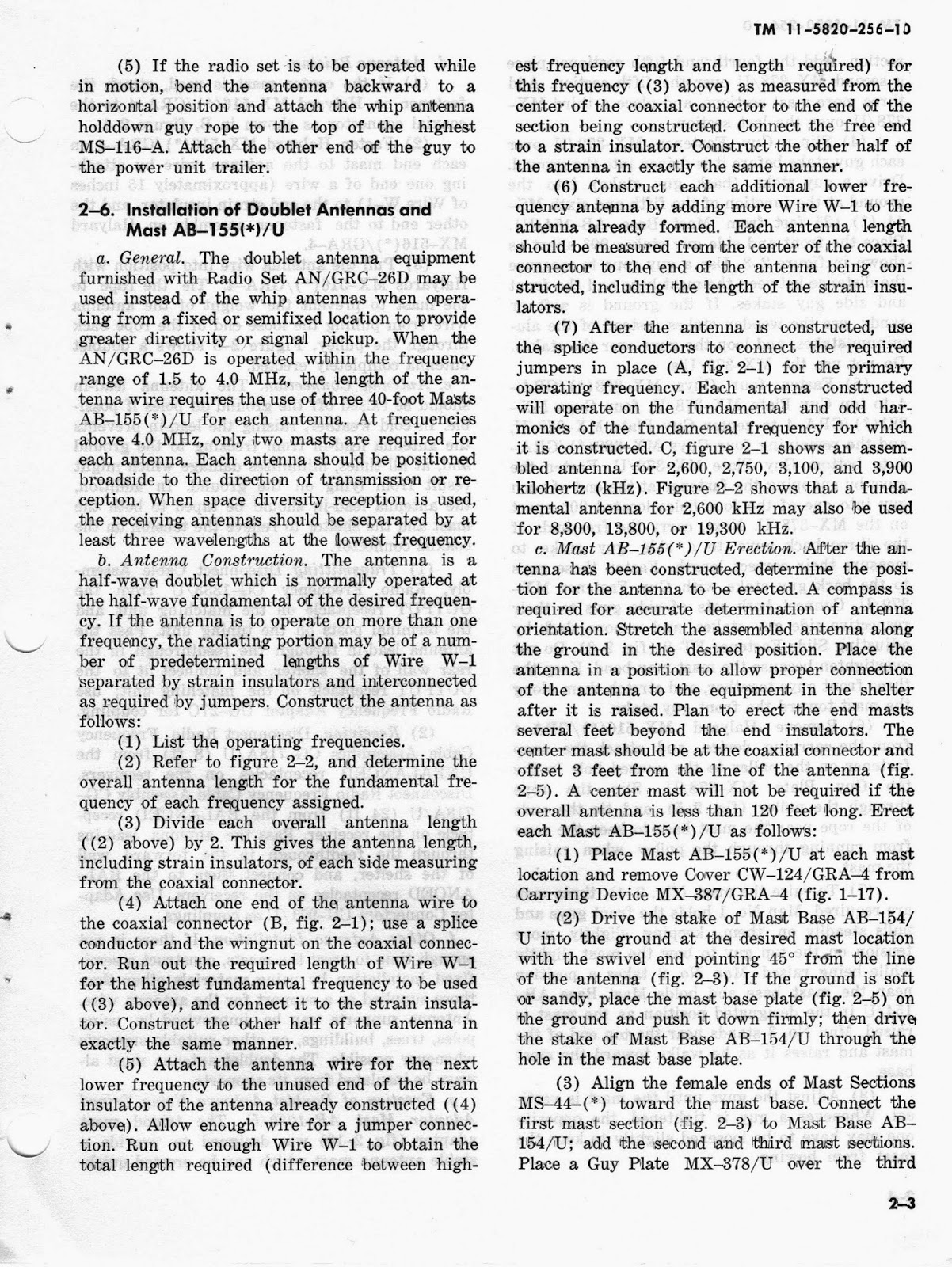
AN/GRC-26D, AB-155A/U Mast Instructions


I decided to post all the information on the AB-155A/U antenna mast from TM 11-5820-256-10, AN/GRC-26D in one location.  This is also for applicable for the MS-44 mast sections.  More information is available here.

WARNING!
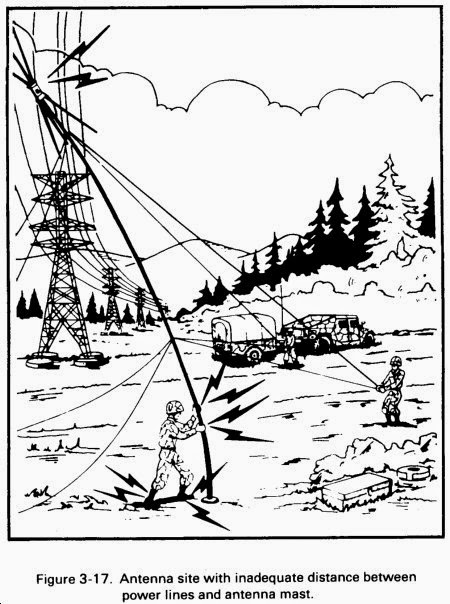
DO NOT INSTALL THIS MAST CLOSER THAN 80 FEET FROM THE NEAREST POWER LINE!!!!!


I raise mine about 150 or more feet from any overhead conductor.  Better to be safe than DEAD.


I did not include Fig. 2.1, page 2-5 which is a pictoral of the wire antenna.  The lengths are for military frequencies although a similar antenna could be built for the amateur bands.

There is also a seller as of the date of this posting selling the U.S. Marine Corp. manual on this mast.  I'm not posting the link to the sale since it will be a dead link if the last manual sells. 


USING THIS OR ANY MAST SAFETY IS YOUR RESPONSIBILTY.  DO NOT INSTALL ANY MAST OR ANTENNA NEAR OVERHEAD CONDUCTORS -- THEY MAY BE LIVE --

EVERY YEAR SOMEONE GETS KILLED USING PORTABLE ANTENNAE ALL OVER THE FAILURE TO LOOK UP AND STAY AT LEAST 80 OR MORE FEET (ACCORDING THE THE TECH MANUALS) FROM OVERHEAD WIRES.


Friday, July 12, 2013

Maritime Radio History Society's Night of Nights -- TONIGHT!

The Night of Nights is tonight, 12 July 2013.

Sadly ships at sea do not use the Morse Code any longer.  Amateur Radio keeps the code alive and tonight is one of the nights that we can promote the use of CW and listen to these historic stations.

Rather than repeat what is already posted; here is a link to the Maritime Radio History Society and all the details and information for tonight's event.

Unfortunately thunderstorms are predicted for my QTH today, tonight and Saturday and maybe even Sunday.  Operating, for anything, for me may be quite a challenge.

73

Sunday, July 7, 2013

More fun with the 13 Colonies Special Event stations than this years Field Day

This blog has been ignored and inactive for way too long, as have my other blogs, web site and on-air activities. I decided to remedy that while on a bicycle ride after Field Day. I generally operate VHF bicycle mobile when I ride and while talking on one of the local repeaters the blog was mentioned. Our QSO also turned to the operating on HF and another QSO was about the G5RV.

 Now that Field Day is behind us I thought I would take to the air waves over my Independence Day vacation. I had a 4 day week end and decided (with permission of my XYL who would rather have gone on a trip somewhere) to spend the time Colony hunting since Field Day was a disappointment. Field Day. I usually do Field Day with one or both local radio clubs. This year I planned operating QRP portable on batteries. At the last minute I decided to help at the club and loan my jump kits. I have one for VHF which we use for a talk-in station and an HF kit that I use for portable operation.

 Well, last minute planning turned to last minute frustration as my trusty IC-735 failed to work on SSB. CW was fine, but no SSB. I swapped out the HM-12 with my David Clark H10-76 headset that I converted to an Acousticom 5730-CA Electret microphone. Still no SSB. So the IC-735 became a CW only station. All was not lost since our club did get on the local news and the IC-735 jump kit was shown quite prevalently.

The search for the 13 Colonies. Independence Day was quite an active day on 20 and 40 meters. I managed to get 10 of the special event stations and made 12 other QSOs that evening with 7 of those being DX contacts.

Friday netted the final 3 Colonies for a clean sweep, but WM3PEN was still elusive. I worked mostly 20 and 40 meters and both had more QSB on Friday than on Thursday with QRN increasing steadily into the night even on 80 meters. All in all though Friday was quite a good day for the little time spent. 17 more DX contacts and 13 more countries added to my DX roster.

Saturday was quiet. Best part of Saturday was that even stations with only an S1 or less were completely readable and I was able to work them. Being on the air only a short time in the morning and again Saturday evening I added only 5 more QSOs to the log.

Sunday...Well the bands are very quiet with severe QSB, WM3PEN is still elusive.
The week end went from being able to have a QSO with someone operating QRP in Michigan to barely being able to hear anyone from Pennsylvania.  Even the Venezuelan stations are quiet.

HF Jump Kit is an Icom IC-735 complete with all filters and an internal keyer.  Power is provided from the IC-PS20 power supply with external speaker.  Antenna matching is via the AT-150. 

 The jump kit is shown packed and ready to set-up.  The kit is made in an MCM CaseGuard Spud-7 Sportsman's Dry Box.  The cables on the left are the a.c. power cables, on top is 50 feet of 10 a.w.g. ground wire, a shorter ground with an alligator clip on on the right.  The lid contains the microphone some patch cords, RF adapters, and Power Pole adapter cables to power the station from an external D.C. source if needed.  I also keep a laminated copy of my license in the kit.

Saturday, September 1, 2012

G5RV in a Sloping-V Configuration

I built a G5RV for portable work about a year ago and have used it on occasion as a flat top and as an inverted-v with good reports.

My back yard is small so I have difficulty installing even the G5RV as a flat top so I decided to give a sloping-v a try so I could get on 80 meters with better results.  The antenna was installed about a month ago.

I have been reading on N.V.I.S. and plan to make a N.V.I.S. antenna over the winter.   This is some of my reasoning on using the G5RV in different configurations including N.V.I.S. 

My sloping-v is not the traditional as the ends are about 7-1/2 feet off the ground.  The apex is about 25 feet from the ground. 

So far I have worked most of the South Eastern states with this antenna on 80.  Not DX by a long shot, but much better than I have been able to work on any other antenna.

Plans are to try this at more of a slope to bring the ends closer to the ground as a true sloper would require and to try it with terminating resistors.  The G5RV is not resonant on any single ham band especially using this configuration.  I do not have the ends terminated nor am I using a counter poise.  I have radials on the vertical and they provide the ground plane for the sloper.

Checking the antenna with my handy-dandy but how accurate MFJ antenna analyzer the antenna has a 1.2:1 VSWR @ 50 ohms @13.848 MHz and 1.5:1 @ 50 ohms @14.000MHz.  The analyzer shows a 1:1 VSWR @ 50 ohms @35.565MHz and again at 75.6935 MHz.  I do not fully trust the MFJ analyzers, but they get close.  I question their accuracy because they will indicate 1:1 at anywhere from 35 to about 60 or 70 ohms.  I have used several and find the same results.  I plan to check this antenna with a GR bridge when the weather gets cool enough. 

This is the G5RV.  A bit difficult to see the V.

Feed point is the white in the lower right corner.

End supported by 2 LCSS aluminum poles

Each end pole is held by a section of PVC pipe attached to angle iron driven into the ground.

This is the apex about 25 feet high.   Guy plate is between the 5th and 6th section of a mast made from MS-44 aluminum sections from an AB-155/A/U
How important is a 1:1 VSWR?  Not important really. I have worked at enough radio stations and done commercial communications to know that the best match is not generally at 1:1.  There are many references that will support this. To me it's just nice to know if something can be 1:1.